Most jewelry with a metal base can be considered for gold plating, ranging from rings, bracelets, and bangles to necklaces, earrings, and pendants. However, not every piece can undergo the exact same process. Plating feasibility and coating durability depend on the base metal, surface condition, existing plating layer, and the structural design of each item.
Three categories requiring thorough pre-inspection before acceptance include glue-set stone jewelry, ultra-fine chains, and pieces with a steel or alloy base experiencing deep peeling. If improperly processed, the new plating layer may turn out uneven, prematurely reveal the underlying base, or damage accompanying details.
Xuong Kim Hoan offers jewelry inspection, consultation, and gold plating quotes at 508 Tran Khat Chan, Hanoi. Customers can send product photos via Zalo before visiting the workshop.
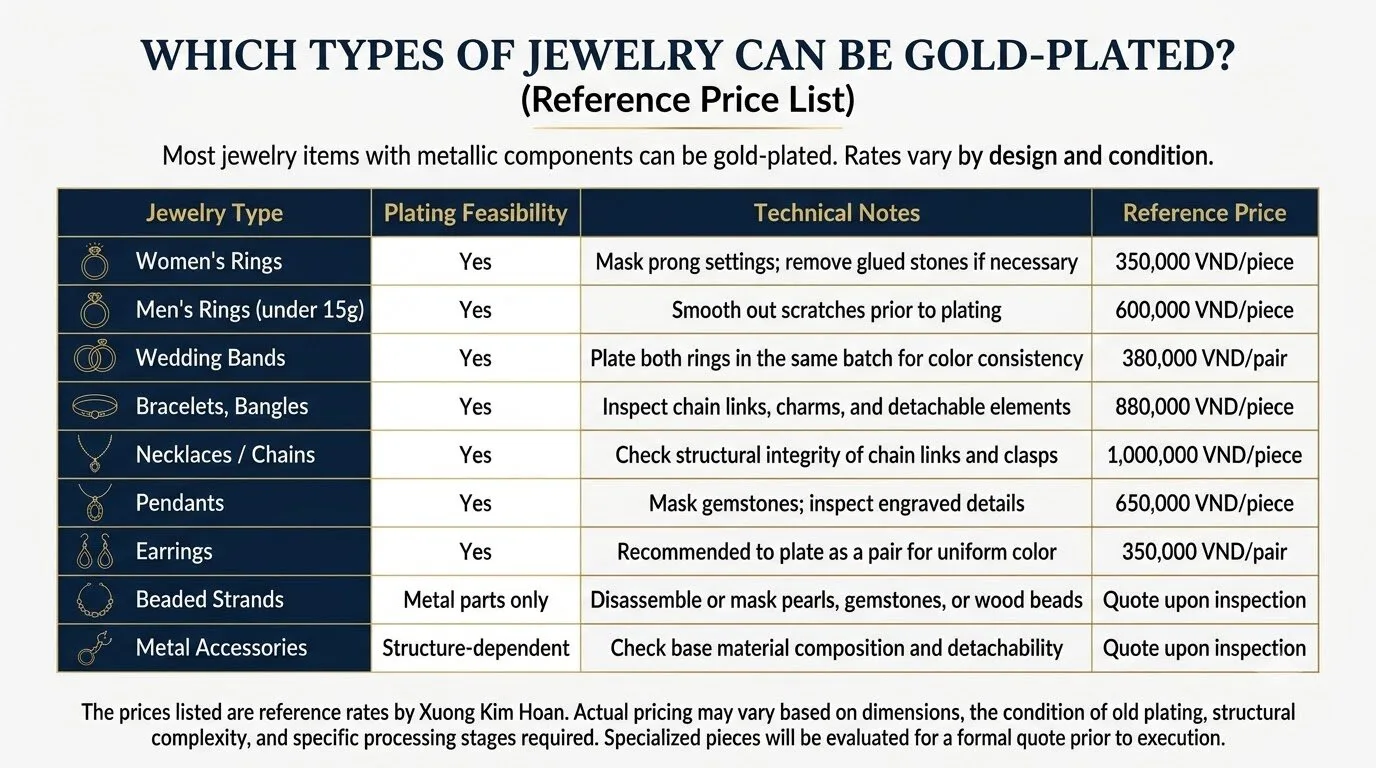
Which Types of Jewelry Can Be Gold-Plated? (Reference Price List)
Most jewelry items with metallic components can be considered for gold plating. Differences lie in structural design, the surface area requiring treatment, and the feasibility of protecting non-plated sections.
Jewelry Type
Plating Feasibility
Technical Notes
Reference Price
Women’s Rings
Yes
Mask prong settings; remove glued stones if necessary
350,000 VND/piece
Men’s Rings (under 4 chỉ / ~15g)
Yes
Smooth out scratches prior to plating
600,000 VND/piece
Wedding Bands
Yes
Recommended to plate both rings in the same batch for color consistency
380,000 VND/pair
Bracelets, Bangles
Yes
Inspect chain links, charms, and detachable elements
880,000 VND/piece
Necklaces / Chains
Yes
Check structural integrity of chain links and clasps
1,000,000 VND/piece
Pendants
Yes
Mask gemstones; inspect engraved details
650,000 VND/piece
Earrings
Yes
Recommended to plate as a pair for uniform color matching
350,000 VND/pair
Beaded Strands
Plating for metal parts only
Disassemble or mask pearls, gemstones, or wood beads
Quote upon inspection
Metal Accessories
Structure-dependent
Check base material composition and detachability
Quote upon inspection
The prices listed in this table are reference rates published by Xuong Kim Hoan, categorized by jewelry type and standard units. Actual pricing may vary based on dimensions, the condition of old plating, structural complexity, and specific processing stages required. For pieces with specialized constructions, the workshop will evaluate and issue a formal quote prior to execution.
Gold plating services for jewelry in hanoi, vietnam
Rings and Wedding Bands: Do Gemstones Need to Be Removed?
Glue-set stones require dedicated inspection because operational temperatures, cleaning solutions, and processing chemicals can compromise adhesive integrity or damage stone surfaces. Depending on the construction, the workshop may mask, disassemble stones, or electroplate only the exposed metal sections.
Wide-band men’s rings or heavily scratched pieces must be carefully evaluated before plating. Shallow scratches can be smoothed via polishing to restore a level, lustrous surface. For deep gouges, electroplating alone cannot fully conceal these structural imperfections.
Wedding bands should be electroplated together in a single batch to ensure an exact color match. Inscriptions of names and wedding dates are photographed before work begins. For urgent requests prior to your wedding day, please refer to reputable white gold plating for wedding rings in Hanoi at Xuong Kim Hoan.
The hallmark “18KGP” stands for 18 Karat Gold Plated; it indicates an external 18K gold coating and does not imply that the entire item is crafted from solid 18K gold. The underlying intrinsic metallic value remains determined by the substrate core below.
Bracelets and Bangles: Why Does the Core Often Show at the Edges?
Rims and outer borders are naturally prone to friction wear.
Fine-chain bracelets undergo link-by-link inspection. Pieces with charms are either disassembled or masked. Plain bangles are considerably simpler to treat than bangles with mounted centerpieces.
On 925 sterling silver, gold plating can wear thin at high-contact points over time. Once the outer layer thins out or flakes, the underlying silver color becomes visible.
Necklaces and Pendants: Are Dainty Chains at Risk of Snapping?
Pieces with sound structural integrity are accepted. Extra-fine chains require in-person inspection; our workshop may decline service to prevent chain breakage.
Clasps should be electroplated alongside chains to achieve identical color matching. Clasps fabricated from differing alloys must be detached and treated individually.
Ultrasonic cleaning suitability must be carefully weighed against gemstone vulnerabilities, setting mechanics, and pendant geometry.
Earrings, Strands, and Accessories: Where Do the Difficulties Lie for Small Items?
Earrings are electroplated in pairs within the same batch to maintain precise shade consistency. If only a single earring remains, the workshop will advise in advance about potential tonal discrepancies.
For beaded strands, the workshop only considers electroplating metallic components such as clasps, decorative spacers, or accent charms. Pearls, gemstones, wood, and resin do not possess conductive metallic surfaces suitable for standard electroplating. Depending on the necklace or bracelet assembly, technicians will assess whether components can be disassembled or masked prior to processing.
Accessories such as charm clasps, key rings, and name tags are handled in small batches, with each individual piece tagged and tracked.
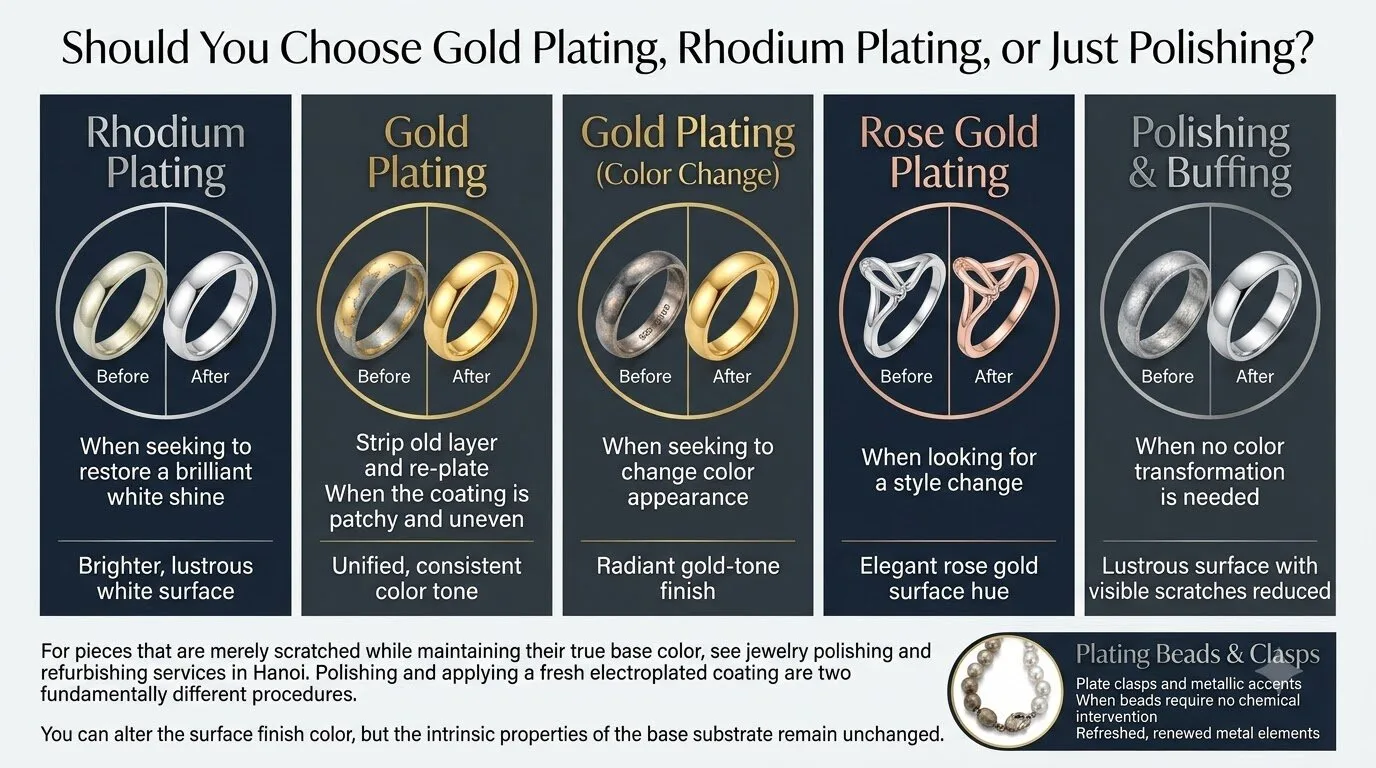
Should You Choose Gold Plating, Rhodium Plating, or Just Polishing?
Jewelry Condition
Recommended Solution
When to Choose?
Expected Outcome
White gold jewelry showing yellow undertones
White rhodium plating
When seeking to restore a brilliant white shine
Brighter, lustrous white surface
Flaking gold layer revealing base metal
Strip old layer and re-plate
When the coating is patchy and uneven
Unified, consistent color tone
Tarnished 925 silver desired in gold hue
Gold plating
When seeking to change color appearance
Radiant gold-tone finish
Desire to convert jewelry into rose gold
Rose gold plating
When looking for a style change
Elegant rose gold surface hue
Minor surface scratches with vibrant base color intact
Polishing & buffing
When no color transformation is needed
Lustrous surface with visible scratches reduced
Beaded necklace with tarnished metal clasp
Plate clasps and metallic accents
When beads require no chemical intervention
Refreshed, renewed metal elements
For pieces that are merely scratched while maintaining their true base color, see jewelry polishing and refurbishing services in Hanoi. Polishing and applying a fresh electroplated coating are two fundamentally different procedures.
You can alter the surface finish color, but the intrinsic properties of the base substrate remain unchanged.
Should you choose gold plating, rhodium plating, or just polishing
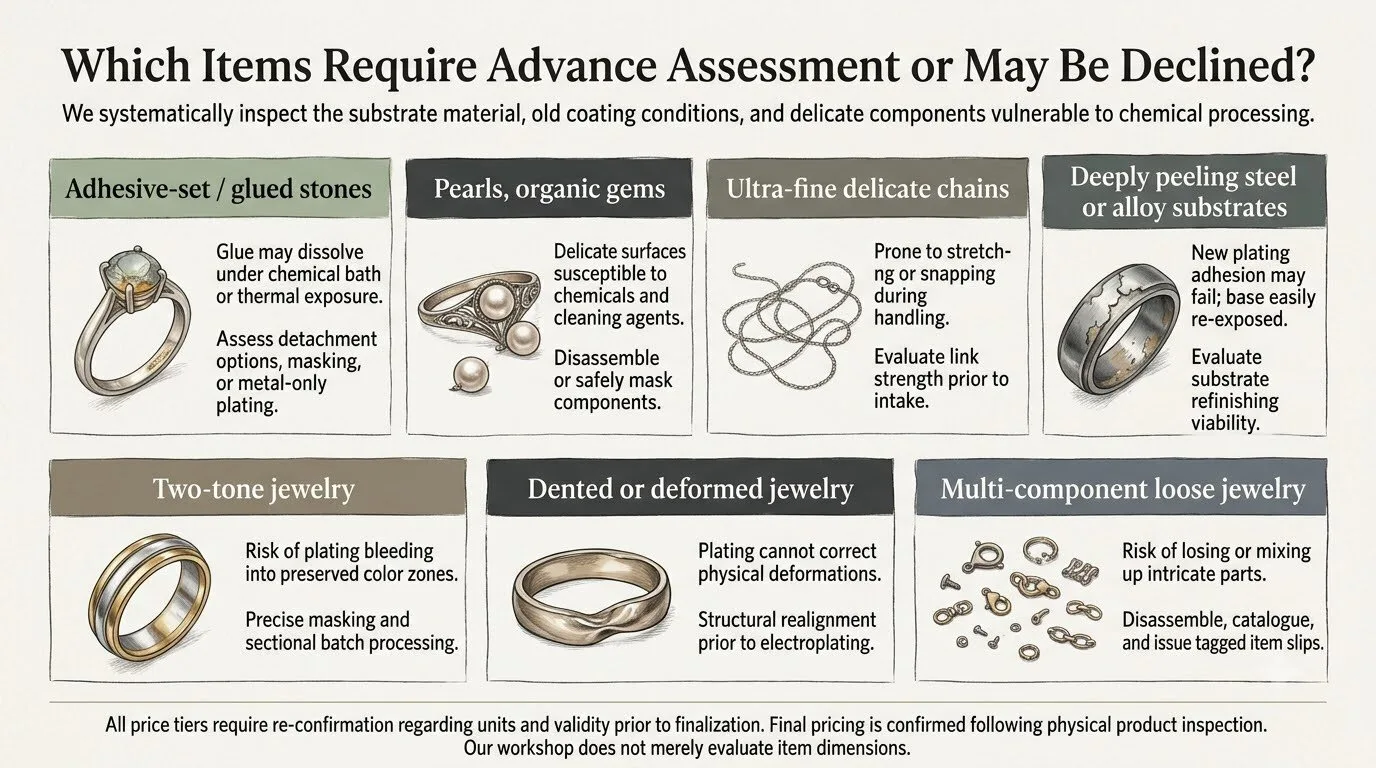
Which Items Require Advance Assessment or May Be Declined?
Product Condition
Associated Risk
Course of Action
Adhesive-set / glued stones
Glue may dissolve under chemical bath or thermal exposure
Assess detachment options, masking, or metal-only plating
Pearls, organic gems
Delicate surfaces susceptible to chemicals and cleaning agents
Disassemble or safely mask components
Ultra-fine delicate chains
Prone to stretching or snapping during handling
Evaluate link strength prior to intake
Deeply peeling steel or alloy substrates
New plating adhesion may fail; base easily re-exposed
Evaluate substrate refinishing viability
Two-tone jewelry
Risk of plating bleeding into preserved color zones
Precise masking and sectional batch processing
Dented or deformed jewelry
Plating cannot correct physical deformations
Structural realignment prior to electroplating
Multi-component loose jewelry
Risk of losing or mixing up intricate parts
Disassemble, catalogue, and issue tagged item slips
All price tiers require re-confirmation regarding units and validity prior to finalization. Final pricing is confirmed following physical product inspection.
Our workshop does not merely evaluate item dimensions; we systematically inspect the substrate material, old coating conditions, and delicate components vulnerable to chemical processing.
Which items require advance assessment or may be declined
What Factors Determine the Cost of Jewelry Gold Plating?
Electroplating costs are not solely determined by the jewelry category. The workshop takes into account total surface area, plating type, and the complexity of required processing stages.
Three primary determinants include:
Surface Area: Wide-band rings, thick bangles, or ornate pendants demand significantly more coverage treatment than minimalist pieces.
Selected Coating: Yellow gold, rose gold, and rhodium plating involve differing chemical processes and prep steps.
Physical Condition: Pieces with peeling coatings, pronounced scratches, or stones requiring masking/removal require extra operational steps.
Special custom quotes are typically required for oversized jewelry, pieces requiring intricate stone protection or disassembly, and items exhibiting severe finish degradation.
Our workshop will inspect the actual condition, present actionable treatment plans, and finalize pricing before proceeding. Currently, the workshop does not publish fixed micron thickness tiers for individual items; customers with specific micron requirements are encouraged to clarify this directly.
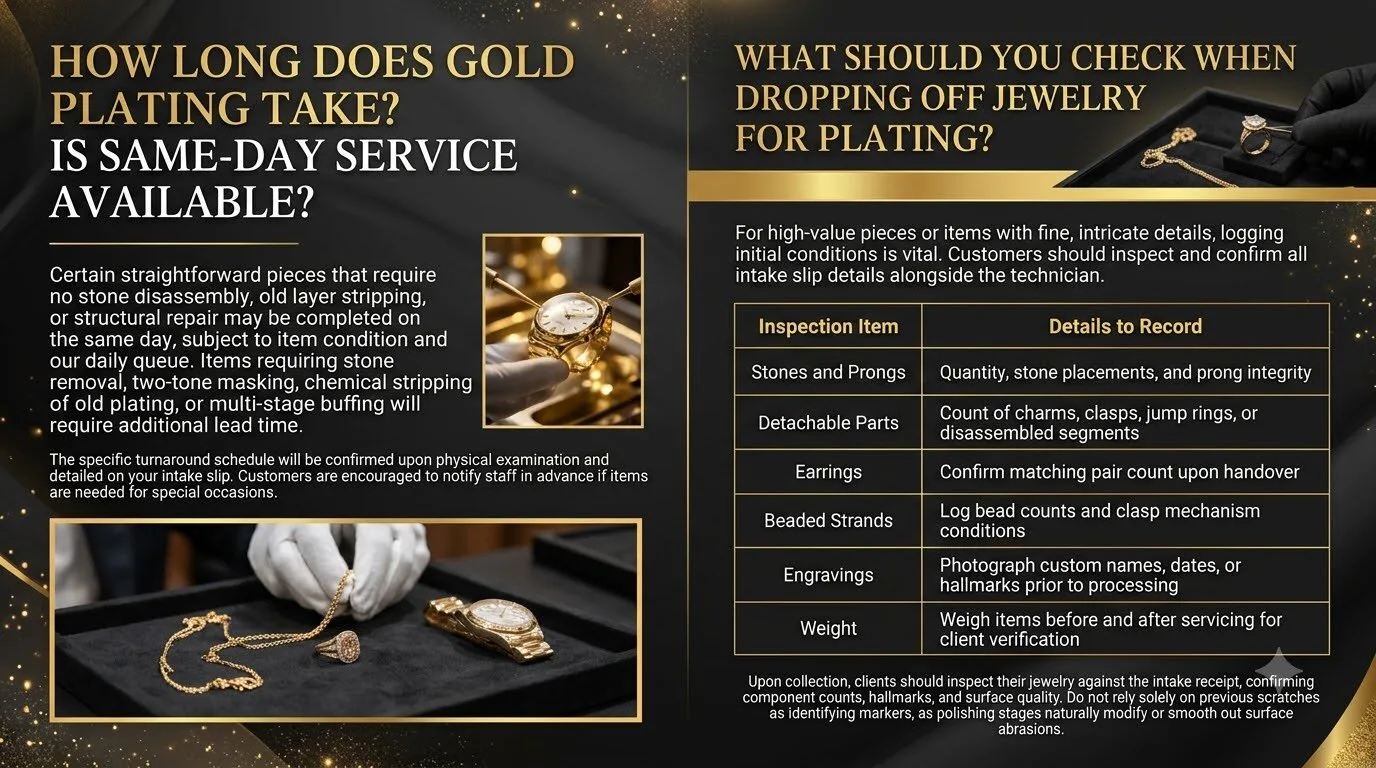
How Long Does Gold Plating Take? Is Same-Day Service Available?
Certain straightforward pieces that require no stone disassembly, old layer stripping, or structural repair may be completed on the same day, subject to item condition and our daily queue.
Items requiring stone removal, two-tone masking, chemical stripping of old plating, or multi-stage buffing will require additional lead time.
The specific turnaround schedule will be confirmed upon physical examination and detailed on your intake slip. Customers are encouraged to notify staff in advance if items are needed for special occasions.
What Should You Check When Dropping Off Jewelry for Plating?
For high-value pieces or items with fine, intricate details, logging initial conditions is vital. Customers should inspect and confirm all intake slip details alongside the technician.
Inspection Item
Details to Record
Stones and Prongs
Quantity, stone placements, and prong integrity
Detachable Parts
Count of charms, clasps, jump rings, or disassembled segments
Earrings
Confirm matching pair count upon handover
Beaded Strands
Log bead counts and clasp mechanism conditions
Engravings
Photograph custom names, dates, or hallmarks prior to processing
Weight
Weigh items before and after servicing for client verification
Upon collection, clients should inspect their jewelry against the intake receipt, confirming component counts, hallmarks, and surface quality. Do not rely solely on previous scratches as identifying markers, as polishing stages naturally modify or smooth out surface abrasions.
Is Gold-Plated Jewelry Real Gold?
Gold-plated jewelry is not the same as solid gold jewelry. Gold plating is a finishing technique where a thin layer of gold is electrochemically deposited onto a base metal such as silver, copper, or a suitable alloy.
Consequently, the item’s inherent value remains largely anchored to its base material, overall craftsmanship, and structural build. It cannot be valued as solid gold simply because of its lustrous golden exterior.
Does the Workshop Accept Jewelry Purchased Elsewhere?
Xuong Kim Hoan accepts third-party jewelry for assessment, including gold, 925 sterling silver, steel, and pre-plated alloy jewelry. Acceptance remains contingent upon base alloy compatibility and physical condition.
Substrates of Gold, 925 Silver, or Platinum: Can be scheduled for refinishing after evaluating surface finish and setting integrity.
Substrates of Copper, Steel, or Pre-plated Alloys: Require an evaluation of the existing coating, peeling extent, and substrate refinishing viability prior to re-plating.
Items with Stones, Pearls, or Leather Elements: These sensitive components cannot be plated directly. The workshop will only consider servicing metal portions if surrounding materials can be safely isolated.
For items featuring alloy bases, customers with known metal sensitivities should inquire about material compositions. As surface plating wears down over time, underlying base metals may come into direct contact with the skin.
Customers can send item photos via Zalo for a preliminary assessment. Upon visiting the shop, our jewelers will evaluate product conditions, suggest tailored approaches, and confirm pricing alongside completion schedules before work commences.
Every product is documented upon drop-off, providing clients with an accurate baseline to cross-check component counts and physical condition upon collection.
Frequently Asked Questions About Jewelry Gold Plating
Should I Avoid Contact with Water After Gold Plating?
Complete water avoidance is unnecessary. However, to prolong coating lifespan, remove jewelry before swimming, bathing in seawater, or using harsh household detergents and abrasive cosmetics. Chlorine, salt, and frequent abrasion accelerate coating wear and dullness.
Does Gold Plating Cause Skin Allergies?
Allergic reactions from wearing plated jewelry are typically tied to the underlying base alloy, intermediate plating layers, or degraded coatings. Nickel is a primary culprit behind jewelry-induced contact dermatitis.
Individuals with metal sensitivity histories should verify alloy compositions prior to wear. If persistent irritation occurs, discontinue wear immediately and consult a dermatologist.
Does Electroplating Cause Weight Loss or Gold Wastage?
Electroplating is not a melting or reshaping process. However, pre-treatment polishing and surface leveling can buff away an infinitesimal amount of metal from the surface.
Clients can request pre- and post-service weight measurements recorded on their intake slip for transparent tracking.
How Often Should Jewelry Be Re-Plated?
There is no universal timeline. Everyday rings and bangles endure significantly higher friction than seldom-worn pendants or earrings.
The ideal re-plating schedule hinges on wearing frequency, handling care, coating condition, and contact friction. The workshop does not set fixed re-plating intervals for any jewelry type.
Can Watches, Bag Hardware, and Metal Accessories Be Plated?
Small metal accessories can be reviewed on a case-by-case basis. Watches in particular require thorough architectural checks and movement/component disassembly prior to chemical submersion. Our workshop evaluates each piece individually before acceptance.
Send Photos for Evaluation and Gold Plating Estimates
If you are uncertain whether your jewelry can be plated, follow these three steps:
Take clear photos of the overall item as well as close-ups of peeling, tarnished, or scratched areas. Send them via Zalo to 0868 600 073, noting whether you prefer yellow gold, white plating, or simple polishing.
Bring the item to 508 Tran Khat Chan, Hanoi between 9:00 AM and 7:00 PM for direct evaluation by our jewelers.
Confirm the technical solution, quote, and completion timeframe before work begins. Upon retrieval, verify your finished piece against the original intake record.
Xuong Kim Hoan – Transparent Condition Checks, Upfront Pricing, and Documented Handover.
If you are unsure which category your jewelry falls under, send your photos today for tailored professional guidance.

 Technical Support